A Simple Explanation of How a U.S. President Can Be Removed or Temporarily Replaced
As search interest surges around the 25th Amendment, many Americans are asking a basic but important question: what does it actually do?
The 25th Amendment to the U.S. Constitution outlines what happens if a president is unable to perform the duties of the office — whether temporarily or permanently. While often mentioned during moments of political tension, it is a procedural safeguard, not an automatic removal tool.
Here’s what it really means, how it works, and why it’s trending again.
What Is the 25th Amendment?
The 25th Amendment, ratified in 1967, was created to clarify presidential succession and incapacity — something the original Constitution left vague.
It answers four key questions:
- Who becomes president if the president dies or resigns?
- What happens if the president is temporarily incapacitated?
- Can a president voluntarily step aside?
- Can a president be declared unfit without resigning?
The Four Sections of the 25th Amendment (Plain English)
Section 1: Presidential Succession
If the president dies, resigns, or is removed, the vice president becomes president — not “acting” president.
Section 2: Vice Presidential Vacancy
If the vice presidency becomes vacant:
- The president nominates a new vice president
- Both the House and Senate must approve the nominee
This has happened before and is straightforward.
Section 3: Voluntary Transfer of Power
This section allows a president to temporarily step aside.
Example:
- The president undergoes surgery or medical treatment
- The president voluntarily declares they are unable to serve
- The vice president becomes Acting President
- Power returns once the president declares themselves fit
This section has been used multiple times.
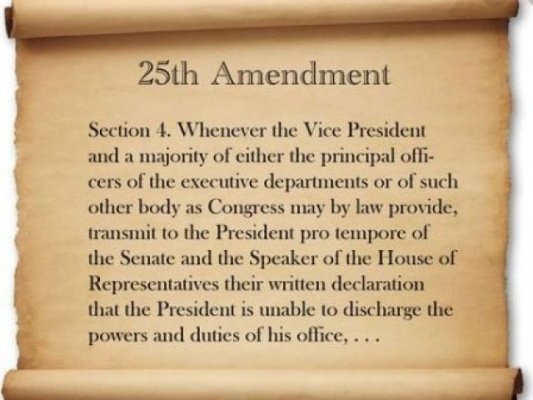
Section 4: Involuntary Declaration of Incapacity
This is the most controversial — and most misunderstood — section.
It allows:
- The vice president
- And a majority of the Cabinet
to declare that the president is unable to discharge the duties of the office.
If invoked:
- The vice president becomes Acting President
- The president can contest the decision
- Congress must vote to uphold it
- A two-thirds majority in both chambers is required to remove power
This section has never been successfully used to permanently remove a president.
What the 25th Amendment Is NOT
The 25th Amendment:
- ❌ Is not impeachment
- ❌ Is not automatic removal
- ❌ Is not triggered by disagreement or unpopularity
- ❌ Is not controlled by Congress alone
It is strictly about capacity, not politics.
Why the 25th Amendment Is Trending Now
Search interest typically spikes when:
- A president’s health is questioned
- Political tensions escalate
- Public statements spark concern
- Media speculation increases
In most cases, the amendment is discussed far more often than it is used.
Has the 25th Amendment Ever Removed a President?
No.
While parts of it have been used for temporary transfers of power, no president has been permanently removed through the 25th Amendment.
Impeachment and removal are separate constitutional processes.
Final Thoughts
The 25th Amendment exists as a constitutional safety mechanism, not a political weapon. Though frequently referenced during moments of controversy, its actual use requires specific conditions, multiple officials, and overwhelming congressional agreement.
Understanding what it does — and what it does not do — is essential when the topic resurfaces in headlines and search trends.