Long before lip stains appeared in sleek tubes and viral makeup tutorials, Moroccan women were using rich plant-based pigments to bring color to the lips and cheeks.
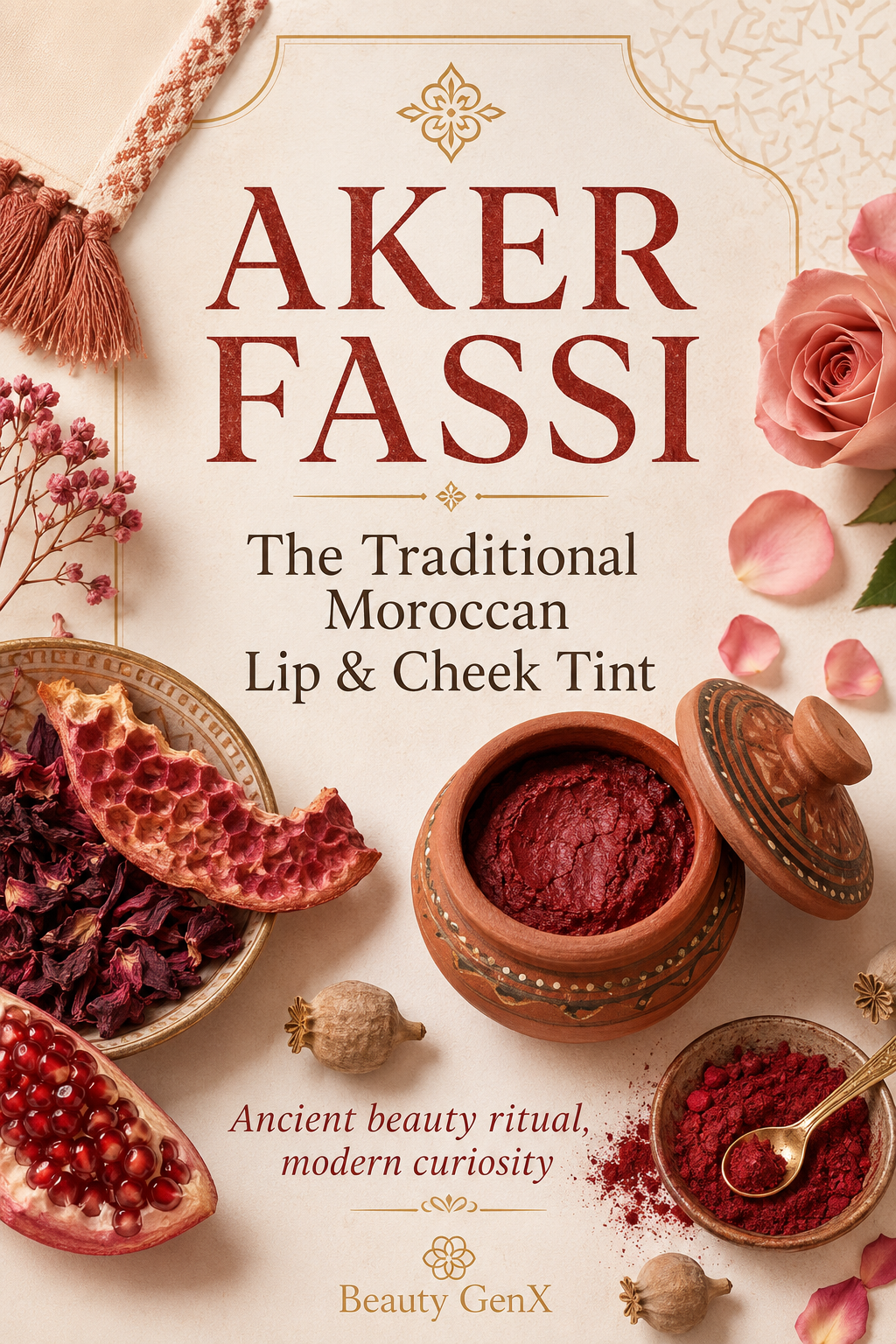
One of the most recognizable is Aker Fassi, a deep red cosmetic traditionally associated with dried poppy petals and pomegranate rind. It may appear as a loose powder, a pressed pigment, or inside a small terracotta vessel that looks more like a handcrafted treasure than a modern cosmetic.
The moment I saw it being demonstrated online, I understood the appeal.
The color is earthy, romantic, and beautifully different from an ordinary lipstick. The clay pot gives the experience a sense of ritual. It feels connected to place, family, craftsmanship, and a time when beauty products were prepared rather than simply purchased.
But BeautyGenX is not only about admiring beautiful things. It is also about understanding what we put on our skin—especially when a product is used on the lips.
So, what exactly is Aker Fassi? How has it traditionally been used? Why is it attracting attention again? And what should modern shoppers check before purchasing it?
What Is Aker Fassi?
Aker Fassi is a traditional Moroccan cosmetic pigment commonly described as a mixture of dried red poppy petals and pomegranate rind or peel.
The ingredients are dried and processed into a concentrated red pigment. Depending on how it is prepared and sold, it may come as:
- A loose red powder
- A pressed tablet
- A pigment coating the inside of a terracotta dish
- A modern balm, tint, soap, or skincare formulation containing Aker Fassi
Traditional versions are often associated with small clay or terracotta vessels. A damp finger or brush is rubbed across the pigment, and the color is then applied lightly to the lips or cheeks.
The result can range from a translucent rosy wash to a deeper brick-red stain, depending on the product, how much water is used, and how many layers are applied. Moroccan sellers and cultural beauty sources consistently describe it as a heritage cosmetic used across Morocco and the wider Maghreb. (MWN Lifestyle)
Is Aker Fassi Really an “Ancient” Beauty Product?
You will often see Aker Fassi described online as an ancient Moroccan beauty secret.
It is more careful and accurate to call it a traditional or ancestral Moroccan beauty practice passed through generations. Reliable sources clearly connect it to longstanding Moroccan and Amazigh beauty culture, but exact claims about when it first appeared are difficult to verify from historical records available online.
That does not make its heritage any less meaningful.
Beauty traditions are often preserved through families, regional practices, artisans, hammam culture, weddings, and everyday routines rather than through formal written histories.
Aker Fassi belongs to a larger Moroccan beauty tradition that also includes:
- Argan oil
- Rose water
- Ghassoul or rhassoul clay
- Moroccan black soap
- Herbal powders
- Hammam exfoliation rituals
These practices reflect a beauty philosophy based on preparation, texture, fragrance, natural materials, and regular self-care—not simply covering the skin with makeup.
Why Poppy Petals and Pomegranate?
The red poppy petals are traditionally valued for their pigment.
Pomegranate rind contributes additional color and has long been used in various traditional dyeing, cosmetic, and household preparations. When processed together, the ingredients can produce the recognizable crimson or brick-red appearance associated with Aker Fassi.
However, consumers should understand that the words “Aker Fassi” do not guarantee one standardized formula.
A modern product may contain:
- Traditional plant ingredients
- Added oils or waxes
- Fragrance
- Synthetic colorants
- Preservatives
- Other botanical powders
- A completely different commercial formula inspired by the traditional product
That is why the ingredient label matters.
A beautifully decorated pot may look traditional while the formulation inside is modern—or may provide very little information at all.
How Is Traditional Aker Fassi Used?
The exact directions vary, but clay-pot versions are usually activated with a very small amount of moisture.
A typical method is:
- Lightly dampen a clean lip brush, cotton swab, or fingertip.
- Rub it gently over the pigment.
- Apply a small amount to the lips or cheeks.
- Build the color gradually rather than applying too much at once.
- Allow the stain to settle before adding another layer.
Some users apply balm afterward because stains can feel drier than conventional lipstick.
Do not pour or spray water directly into a clay pot unless the manufacturer specifically instructs you to do so. Excess water can damage the vessel, create a messy paste, or introduce moisture that affects the product’s cleanliness.
Always follow the instructions for the exact product purchased rather than assuming every Aker Fassi formula should be used identically.
Why Is Aker Fassi Trending Again?
Modern beauty shoppers are rediscovering traditional products for several reasons.
The color is distinctive
Aker Fassi is known for a warm red that can resemble rose, terracotta, crimson, or brick depending on the formulation and skin tone.
It does not necessarily create the same heavy, opaque appearance as conventional lipstick. Applied lightly, it can look like color coming through the skin rather than sitting on top of it.
The ritual feels special
There is something undeniably appealing about dipping a brush into a handcrafted terracotta vessel instead of twisting open another plastic tube.
Beauty is not always only about the final result. Sometimes the ritual itself helps us slow down and enjoy taking care of ourselves.
Consumers are interested in cultural beauty traditions
Social media has made it easier to discover beauty practices from Morocco, India, Korea, Japan, West Africa, the Middle East, Latin America, and Indigenous communities.
That curiosity can be positive when traditions are presented respectfully and accurately—not stripped of their culture and repackaged as a newly invented trend.
It photographs beautifully
The rich pigment, dried petals, pomegranate, and painted clay vessels are visually striking. That has helped Aker Fassi appear in Instagram videos, Pinterest posts, beauty demonstrations, and product collections.
But visual beauty should never replace careful shopping.
Natural Does Not Automatically Mean Tested
This is the most important part of the conversation.
A seller may describe a product as:
- Natural
- Traditional
- Chemical-free
- Handmade
- Pure
- Authentic
- Organic
Those words do not prove that the finished cosmetic has been independently tested for contamination.
Natural materials can still contain unwanted impurities. Clay, mineral pigments, soil-grown botanicals, manufacturing equipment, glazes, dyes, and packaging can potentially introduce contaminants.
The concern is especially relevant for a lip product because small amounts may be swallowed during ordinary wear.
The U.S. Food and Drug Administration recommends that lead present as an impurity in cosmetic lip products and externally applied cosmetics not exceed 10 parts per million. The FDA has also tested cosmetics for metals including arsenic, cadmium, chromium, cobalt, lead, mercury, and nickel. (U.S. Food and Drug Administration)
This does not mean that Aker Fassi products automatically contain lead or that every terracotta vessel is unsafe.
It means that shoppers should not accept “natural” as a substitute for ingredients, traceability, and testing.
What to Check Before Buying Aker Fassi
Before applying any unfamiliar pigment to your lips, look for the following information.
A complete ingredient list
The seller should disclose what is actually in the finished product—not only describe its traditional inspiration.
Be cautious when a lip cosmetic has no ingredient list at all.
Manufacturer or responsible company information
A professional listing should identify who made or distributed the product and provide a way to contact the company.
Country of manufacture
A product may use Moroccan ingredients while being formulated or packaged elsewhere. That is not necessarily a problem, but the information should be transparent.
Batch or lot identification
A batch number helps connect the product to its manufacturing and quality-control records.
Heavy-metal testing
For a clay-pot product, ask whether testing covers both:
- The cosmetic pigment
- The terracotta vessel or glaze
A seller’s statement that the product is “lead-free” is less persuasive than a recent third-party Certificate of Analysis identifying the laboratory, batch, testing method, and results.
Clear directions and warnings
The directions should make sense for a product marketed for the lips and cheeks.
Wording such as “for external use only” on a lip stain deserves clarification because a lip product is likely to be ingested in trace amounts through normal wear.
Real customer reviews
Reviews can help reveal:
- Broken pots
- Weak or inconsistent pigmentation
- Unusual odor
- Irritation
- Packaging problems
- Misleading sizing
- Differences between the advertisement and actual product
A lack of reported allergic reactions is encouraging, but it cannot confirm the absence of heavy metals or other contaminants. Those problems may not cause an immediate visible reaction.
Questions to Send the Seller
A serious seller should be willing to answer reasonable safety questions.
You can send:
I am interested in your Aker Fassi lip and cheek tint. Can you provide the complete ingredient list, country of manufacture, and a recent independent Certificate of Analysis for the finished pigment and terracotta vessel? I would specifically like to see testing results for lead, cadmium, arsenic, and mercury.
A vague response such as “It is natural, so it is safe” does not answer the question.
Neither does a chatbot response based only on the product description.
Artificial intelligence shopping assistants can summarize what a seller wrote, but unless they provide a specific laboratory document, they are not independently verifying the product.
Should You Try Aker Fassi?
Aker Fassi is a beautiful subject to explore, and a well-made, properly labeled, responsibly tested version may be an enjoyable addition to a beauty routine.
But I would not purchase an unlabeled clay pot solely because it looks authentic or because a creator with a large following demonstrated it.
Influence is not laboratory testing.
Packaging is not proof.
Tradition is not the same as modern quality control.
The ideal product would honor the original Moroccan beauty practice while also providing the transparency expected from a cosmetic sold today.
A Respectful Way to Appreciate Traditional Beauty
It is possible to celebrate Aker Fassi without treating Moroccan culture like a temporary social-media aesthetic.
That means:
- Acknowledging its Moroccan and Amazigh heritage
- Learning how it has traditionally been prepared and used
- Supporting transparent Moroccan artisans and businesses
- Avoiding exaggerated medical or skincare claims
- Asking for modern safety documentation
- Giving credit rather than presenting it as a newly invented Western trend
Traditional beauty practices deserve both admiration and respect.
Beauty After 50: Curiosity Without Pressure
Part of creating BeautyGenX is recognizing that beauty after 50 does not need to mean trying to look 25.
It can mean becoming curious again.
It can mean rediscovering color.
It can mean learning about the rituals women used before us.
It can mean finally deciding that taking care of our skin, hair, and appearance deserves a place on our calendar—not because we are inadequate, but because we are worthy of care.
I have spent years working, building, planning, and taking care of responsibilities. I am ready to pay more attention to my skin and to the things that make me feel polished, feminine, and beautiful.
A product like Aker Fassi represents more than red pigment in a pot.
It reminds us that beauty can be cultural, practical, artistic, and deeply personal.
The BeautyGenX Verdict
Aker Fassi is a visually beautiful traditional Moroccan lip and cheek pigment with a fascinating cultural history and an understandable modern appeal.
The best approach is neither fear nor blind enthusiasm.
It is informed curiosity.
Admire the ritual.
Learn its history.
Respect the culture.
Read the ingredients.
Ask for testing.
Patch-test a properly documented product before wider use.
And remember: a product can be natural, traditional, and beautiful while still needing to meet modern expectations for safety and transparency.
Ancient inspiration may capture our attention. Informed choices are what protect our beauty.