If you’ve spent any time near K-beauty content, you’ve heard these ingredient names repeated constantly, often without much explanation of what they actually are or how well-supported the claims around them really are. Here’s a straightforward breakdown, organized honestly by strength of evidence rather than by hype.
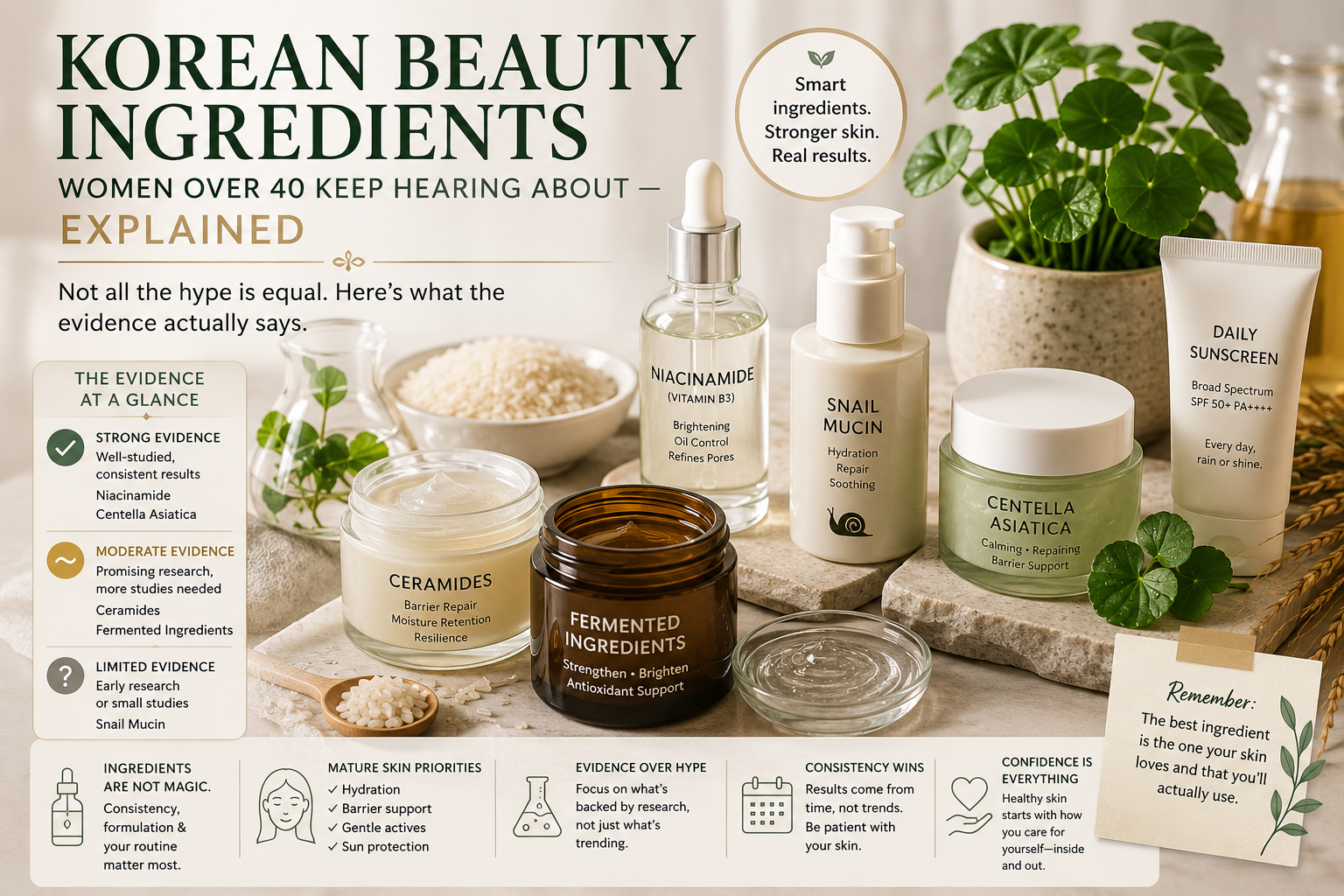
Niacinamide (Vitamin B3) — Strong Evidence
Niacinamide is one of the most thoroughly studied skincare ingredients available, backed by real clinical research supporting its role in supporting the skin barrier, improving the look of pores, and evening tone over time. It’s generally well-tolerated and works across most skin types, which makes it one of the safest, most evidence-backed places to start if you’re new to actives.
Centella Asiatica (Cica) — Moderate, Meaningful Evidence
A plant long used in traditional medicine, centella asiatica contains compounds (including madecassoside and asiaticoside) associated with calming inflammation and supporting wound healing and the skin barrier. It’s a genuinely useful ingredient for sensitive, reactive, or barrier-compromised skin — a common concern for mature skin.
Ceramides — Moderate to Strong Evidence
Ceramides are lipid molecules that are a structural part of the skin’s own barrier. Formulas built around them help support and reinforce that barrier, which matters increasingly with age as natural ceramide levels tend to decline. This isn’t a uniquely Korean ingredient — it’s well-supported in dermatology generally — but K-beauty formulas frequently feature it prominently.
Snail Mucin — Popular, but Limited Evidence
Genuinely one of the most recognizable K-beauty ingredients, snail mucin (a secretion collected without harming the snail, typically via a mesh-crawling process) is generally well-tolerated and pleasant to use. There is at least one small published study — women aged 45 to 65 — showing improvement in skin roughness, firmness, and elasticity. But dermatologists are clear that there isn’t large-scale, long-term controlled research confirming these effects, so it’s reasonable to try with modest expectations rather than as a proven anti-aging solution.
Fermented Ingredients (Galactomyces, Propolis) — Traditional, Evidence Still Developing
Fermentation is used in Korean skincare to break ingredients down into smaller molecules, theoretically improving absorption. Propolis, collected by bees, has some evidence for antimicrobial and soothing properties. These ingredients are widely used and generally well-tolerated, but the specific skincare claims made about them currently have less controlled human research than niacinamide or centella.
Traditional Botanicals (Mugwort, Ginseng) — Cultural Significance, Limited Controlled Research
Mugwort and ginseng carry real historical significance in Korean traditional medicine (hanbang) and are popular in modern K-beauty formulations for soothing and brightening claims respectively. They’re generally considered safe for most skin types, but currently lack the kind of large controlled human trials that back niacinamide or sunscreen.
How to Use This List
Prioritize your budget and routine real estate toward the strong-and-moderate-evidence ingredients — niacinamide, centella, ceramides — and treat the rest as genuinely enjoyable extras rather than essentials. None of this means the less-studied ingredients don’t work; it means the research hasn’t caught up to the popularity yet, which is worth knowing before you spend based on marketing alone.