
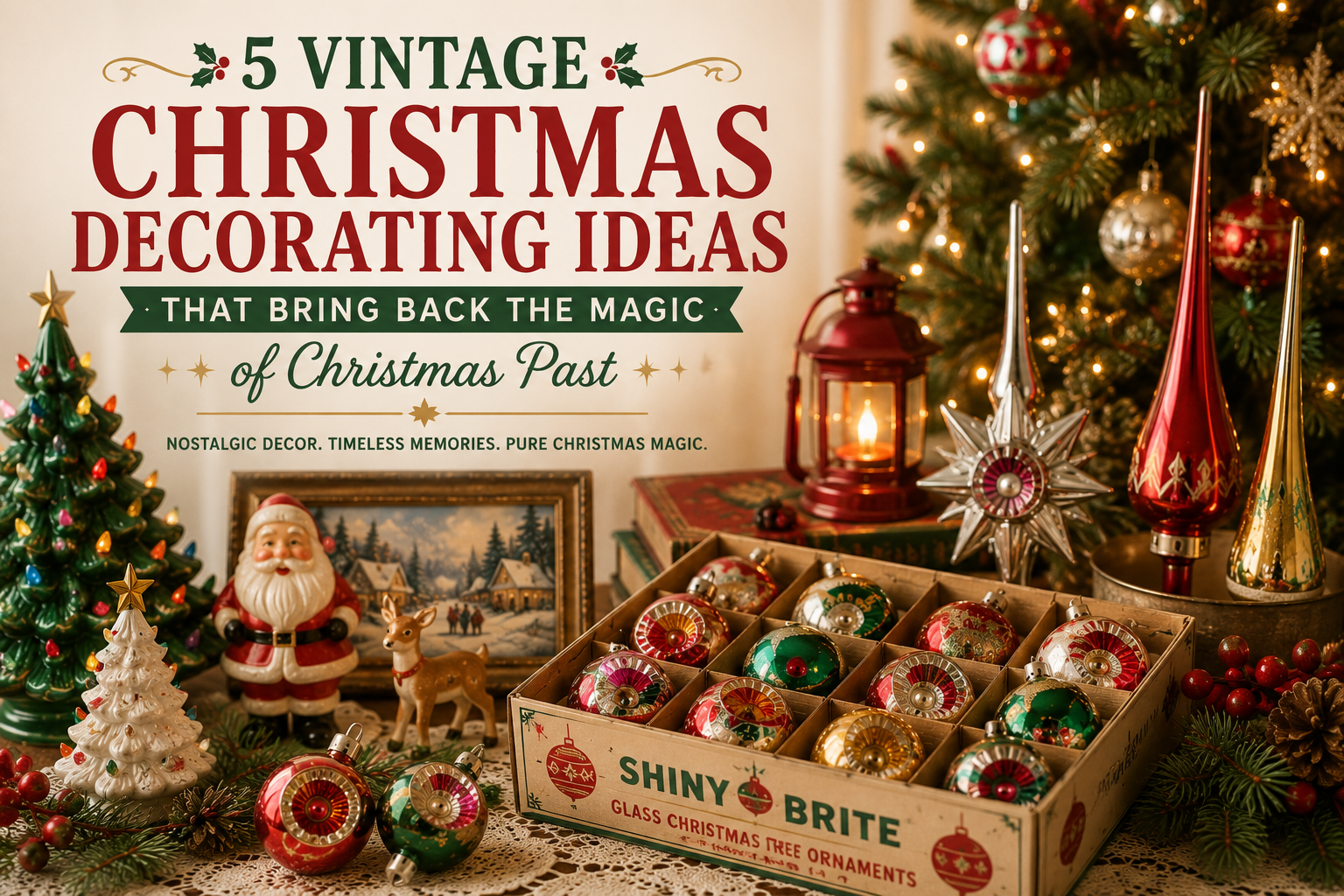
There’s a specific kind of tree everyone over a certain age remembers, even if the details are a little fuzzy: the glass spire on top catching the light just right, the ornaments that had been in the family longer than anyone could say, the ceramic tree glowing on a side table nobody was allowed to touch. If any part of that just gave you a flash of a very specific living room from your childhood, this one’s for you.
1. Vintage Glass Christmas Tree Toppers
Before plastic stars and battery-lit angels took over, the classic finish on top of the tree was almost always glass — a tall spire, a jeweled finial, or an indented “reflector” star designed to catch tree light and throw it back in every direction. Glass finial tree toppers trace back to German glassmakers in the late 1800s, and the style stuck around for the better part of a century for a simple reason: nothing plastic quite replicates the way real glass scatters light.
What to look for. Genuinely old glass toppers tend to have some visible weight to them, a slightly imperfect hand-painted or hand-silvered finish, and a metal cap or clip rather than a modern plastic base. Reflector-style toppers — the ones with a deep indent and a starburst pattern inside — are a specific and especially collectible category, since the indent technique took real skill to produce without cracking the glass.
What’s usually reproduction. A topper that’s uniformly perfect, machine-glossy, or attached with a bright plastic clip is almost certainly a newer piece — not necessarily a bad thing if you just love the look, but worth knowing before you pay a vintage price for it.
2. Vintage Glass Christmas Ornaments
If your family tree had glass balls in bold reds, greens, and silvers with a slightly worn, softly reflective finish, there’s a very real chance some of them were Shiny Brite — the ornament brand most responsible for putting glass balls on American trees in the first place.
The real history, briefly. Shiny Brite was founded in 1937 by Max Eckardt, a German-American businessman who’d been importing hand-blown glass ornaments from Germany and saw the coming war as a real threat to that supply chain. He partnered with the Corning Glass Company, which adapted its light bulb manufacturing process to produce clear glass ornament balls, then shipped them out to be hand-decorated. The first machine-made batch shipped to Woolworth’s in December 1939. Ornaments from this era were silvered on the inside with silver nitrate — which is where the “shiny” actually comes from.
Wartime ornaments look different, on purpose. During World War II, silvering material and lacquer paint became scarce, so wartime-era Shiny Brites were often left unsilvered — clear glass with thinner, simpler stripe patterns — and their metal caps and hooks were swapped for cardboard and yarn due to metal rationing. If you’ve got an ornament like this, it’s not a lesser piece; it’s a small, real artifact of that specific moment in production.
Genuinely vintage vs. modern reproduction. Shiny Brite’s popularity faded through the 1960s as plastic ornaments and aluminum trees took over, and the original company didn’t continue in its original form past that point. In the 1990s, designer Christopher Radko acquired rights to the Shiny Brite name and began producing new ornaments under that label — genuinely well-made, but a modern reproduction, not a piece from the original 1940s–1950s run. If authenticity matters to you, look closely at the cap: older caps tend to be simple crimped metal, sometimes marked “Shiny Brite” with a country of origin, while modern reissues are typically cleaner and more uniformly finished.
Beyond Shiny Brite. Mercury glass ornaments (blown glass with a silvered interior, a broader category that predates and outlasted any single brand), indented “reflector” ornaments, teardrops, and glass bells were all common styles across multiple manufacturers of the era — you don’t need a Shiny Brite-marked piece specifically for an ornament to be genuinely vintage.
3. Old-Fashioned Christmas Tree Decorating
What actually made older family trees feel the way they did wasn’t any single ornament — it was the accumulation. A tree that had glass ornaments from three different decades, a few handmade pieces from a school craft project, tinsel draped (or, depending on the household, thrown) over the branches, and a strand or two of the big, old-fashioned multicolor C7 or C9 bulbs that cast the whole room in warm colored light.
The look, recreated safely today. You can absolutely bring this feeling back without needing anything actually old. Modern warm-toned multicolor LED strands get you close to that old bulb glow without the heat or fragility of the originals. Metallic tinsel, used in moderation and draped rather than clumped, still reads as authentically old-fashioned. A few genuinely handmade pieces — paper chains, a felt ornament, something a kid actually made — do more for the “collected over generations” feeling than any amount of matched, purchased decor.
One honest caution. Some older Christmas decorating practices from decades past aren’t things to recreate today — this isn’t the place for a full safety rundown, but it’s worth using common sense: modern LED lighting is simply safer and more efficient than older bulb technology, and if you’re using genuinely old lights or ornaments from a family collection, it’s worth checking their condition (frayed cords, brittle wiring, sharp broken glass edges) before putting them anywhere near a live tree.
4. Vintage Christmas Table & Home Decor
The tree usually gets all the attention, but a genuinely nostalgic Christmas home had just as much going on everywhere else — a ceramic tree glowing on a side table, candle holders that came out once a year, holiday linens with a specific, slightly dated floral or plaid print, and maybe a Christmas village slowly assembled piece by piece over several years.
Ceramic Christmas trees. These small, glowing trees — usually with tiny colored plastic light pegs pushed through drilled holes — were often genuinely handmade, frequently in home ceramics classes, which is part of why so many families had one that was truly one of a kind rather than store-bought.
Candle holders and figurines. Brass or glass candle holders, ceramic Santa and reindeer figurines, and small nativity sets in a specific, slightly worn style all fall into this same nostalgic category — pieces that tend to show up at exactly one time of year and carry outsized emotional weight for it.
Holiday linens. Tablecloths, napkins, and runners in a specific, dated print — think poinsettias, plaid, or a retro Santa motif — are some of the easiest and most affordable vintage finds, and they do a lot of visual work for very little cost.
Christmas villages. Small lit ceramic or resin buildings, assembled into a miniature town scene, were a genuinely popular decorating tradition for decades — often built up gradually, one new building added each year, which is exactly the kind of “collected over time” detail that makes vintage decor feel real rather than staged.
5. Vintage Christmas Decorations Worth Hunting For
If any of the above sparked a genuine “I need to find one of these” feeling, here’s where to actually look, and how to shop smart once you’re there.
Where to look. Estate sales are consistently the best source for genuinely old pieces in real condition, since they’re often selling an entire household’s accumulated decor at once. Antique malls and stores are more curated (and priced accordingly) but reliable for authenticated pieces. Thrift stores are a gamble but occasionally turn up real finds at a fraction of the price. Flea markets fall somewhere in between. Online resale marketplaces (Etsy, eBay, and similar platforms) offer the widest selection but require the most careful eye, since you’re relying entirely on photos and a seller’s description.
How to spot a reproduction. As covered above with Shiny Brite specifically, look closely at caps, hooks, and finishing — older pieces tend to show some age-consistent wear, slightly imperfect hand-finishing, and materials (metal rather than plastic caps, for instance) appropriate to their claimed era. A piece that looks flawless and machine-uniform is worth a second look before assuming it’s original.
How to check condition. Hold glass ornaments up to light and check for hairline cracks, especially near the cap. Check ceramic pieces for chips, repairs, or replaced parts (a ceramic tree with mismatched light pegs, for example, has likely had some pegs replaced over the years — not necessarily a problem, just worth knowing). For anything electrical — old light strands especially — check the cord and plug condition before ever considering actual use.
One honest note on value. Age alone doesn’t make something valuable. Condition, rarity, completeness (original box, all original parts), and current collector demand all matter more than “old” as a category. If you’re buying purely because you love a piece, that’s reason enough — just don’t assume every old ornament is a hidden treasure without some actual research into what similar pieces are genuinely selling for.