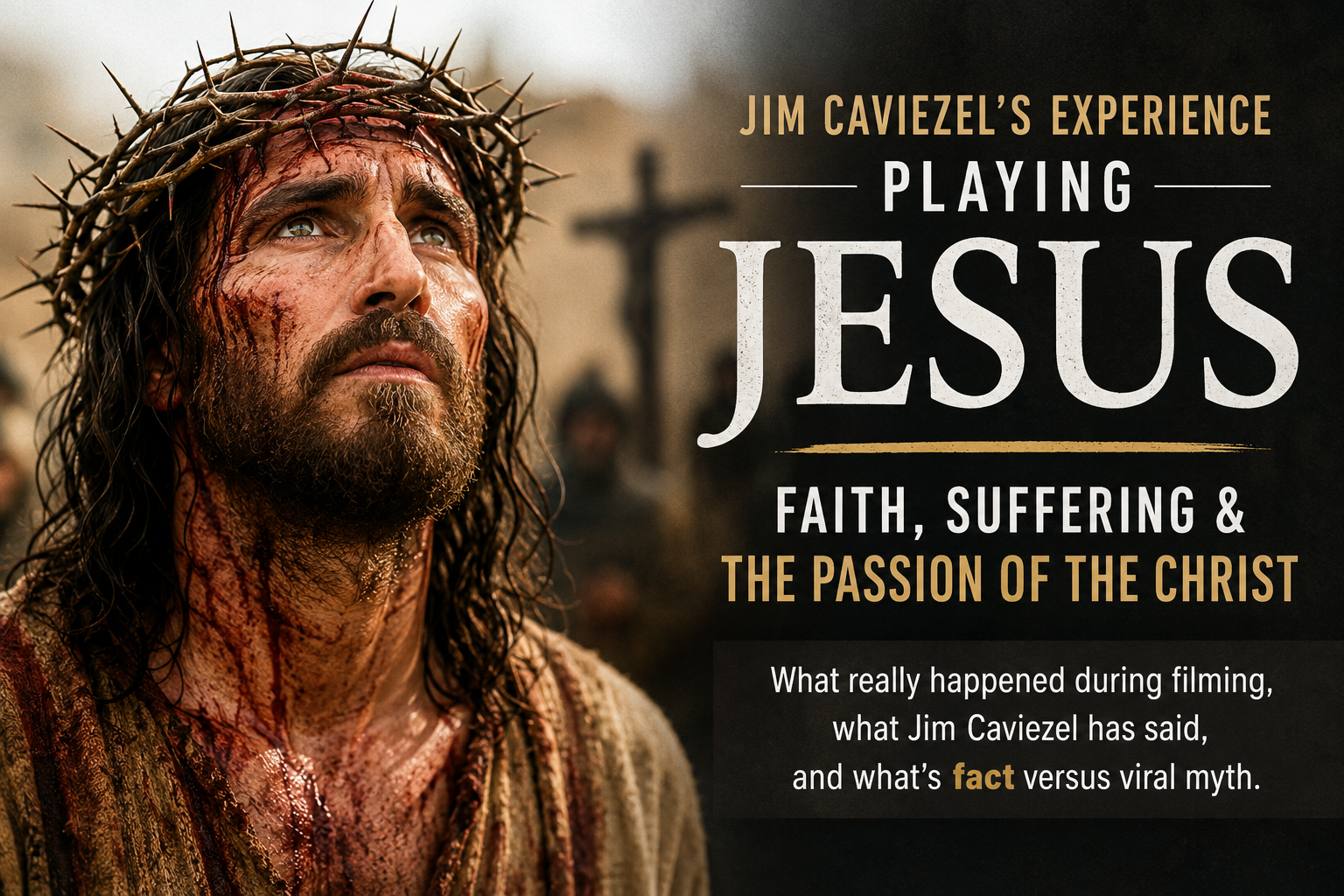
Jim Caviezel was 33 years old — the age Christian tradition holds Jesus was at the crucifixion — when he took on the role of Jesus in Mel Gibson’s The Passion of the Christ. More than two decades later, he’s still asked about it constantly, and he still talks about it in strikingly consistent terms: as the hardest thing he’s ever done, and as the experience that most changed his relationship with his own faith.
How Jim Caviezel Was Cast as Jesus
According to Caviezel’s own account in a 2004 interview with the National Catholic Register, the approach was almost comically indirect. His agent got a call about a meeting for a film called Mavericks — which, Caviezel later learned, was a cover story producer Steve McEveety and Gibson used just to get him to sit down. The real meeting, at a picnic table in Malibu, ran three and a half hours, and ended with Gibson pitching the project he’d apparently been thinking about for years.
In a separate interview with CBN, Caviezel described Gibson calling him personally the day after offering him the role — specifically to talk him out of it, warning him plainly that playing Jesus could mean he’d “never work again” in Hollywood. Caviezel has said he told Gibson he understood the risk and wanted the role anyway.
What Filming Actually Required
The lightning strike is the one part of this story that’s independently documented, not just self-reported. During filming of the Sermon on the Mount scene, lightning struck the set, hitting Caviezel and also striking assistant director Jan Michelini (who was reportedly struck a second time separately during production). This wasn’t only Caviezel’s own retelling years later — Entertainment Weekly reported on the strike contemporaneously in 2003, and producer Steve McEveety spoke about it publicly at the time, confirming the main bolt hit Caviezel while a fork of it struck Michelini. A Snopes fact-check of a widely circulated list of Caviezel’s on-set injuries specifically identified the lightning strike as one of the claims with real, contemporaneous documentation behind it.
Beyond the lightning strike, most of what’s known about the physical toll of filming comes directly from Caviezel himself, repeated consistently across multiple interviews over the years:
- Shoulder dislocation. Caviezel has described dislocating his shoulder while being hoisted up for the crucifixion scenes, at one point recalling a moment of prayer during filming: “Ok God, this is where I need a hug to stay up here because this hurts like crazy!”
- Accidental injury during the scourging scenes. Multiple sources, including IMDb’s production trivia page (itself partly drawing on Caviezel’s own interview statements) describe him being struck by an actor’s whip during the flagellation scenes, resulting in a significant scar.
- A 150-pound cross falling on him. In a 2023 Fox News Digital interview, Caviezel described the cross falling on his head during filming, causing him to bite through his tongue and cheek — an injury he says is visible in the finished film.
- Illness during production. In a 2004 National Catholic Register interview, Caviezel said plainly: “I had dislocated my shoulder. On top of that I had pneumonia. I got really sick.” He’s also described filming crucifixion scenes in bitterly cold conditions over an extended shoot.
- Long-term health effects he attributes to the lightning strike. In more recent interviews, including a 2023 Fox News Digital conversation and a 2025 podcast appearance, Caviezel has said the lightning strike led to heart problems requiring two separate heart surgeries — one at Stanford shortly after filming, and a second open-heart procedure at the Cleveland Clinic in 2014. In the 2025 podcast interview specifically, he described a dramatic, brief loss of consciousness at the moment of the strike. These are Caviezel’s own account of his medical history; this article isn’t independently verifying his surgical or medical records, and presents this as what he has said rather than as externally confirmed fact.
Fact vs. Viral Story: What’s Solid, What’s Less Certain
A widely circulated social media list (a “copypasta,” as Snopes describes it) has spread for years claiming to catalog Caviezel’s injuries from the shoot. Snopes’ investigation found the list drew from two real sources — IMDb’s trivia page and Caviezel’s own interview statements — meaning most individual claims trace back to something he actually said, even if the “viral list” format itself wasn’t something Caviezel or the production ever issued as an official statement.
Worth being specific about: some details that circulate online (a precise sub-zero filming temperature, migraines specifically tied to prosthetic makeup swelling affecting his depth perception) appear in secondary entertainment coverage but couldn’t be traced back to a direct Caviezel quote or contemporaneous source during our research for this piece. That doesn’t necessarily mean they’re false — but it does mean they belong in a different category than the lightning strike (externally documented) or his shoulder and illness (his own repeated, consistent, on-record statements).
What Caviezel Has Said About Faith
Caviezel was already a practicing Catholic before taking the role, and he’s described the experience as deepening rather than initiating his faith. In the same 2004 interview where he detailed the physical toll of filming, he also said this about how he came to feel about the role itself: “I really believe that she was setting me up, getting me ready to play her Son. She architected this whole thing” — referring to what he’s described as a lifelong devotion to Mary that he felt had prepared him for the part.
He’s spoken about praying the rosary and returning to more regular confession during the production, according to reporting in Messenger of Saint Anthony, and told the Catholic News Agency in a later interview: “When I played Jesus, I prayed a lot. I asked God to show me how I could present Jesus in the most accurate way. How to make the viewers feel closer to him.”
It’s worth being clear about what this article is not claiming. Caviezel has described his own suffering during filming as spiritually significant to him personally — that’s his own stated experience, and it’s reasonable to take him at his word about his own faith. This is different from claiming that what he went through was equivalent to what Christ endured, or that any specific on-set event (the lightning strike, an injury) was a deliberate act of God — Caviezel himself, in the interviews reviewed for this piece, generally frames these events as his own faith interpreting difficult, painful circumstances, not as making a theological claim on behalf of Scripture.
Why This Story Still Resonates
Part of what keeps this story circulating, more than twenty years after the film’s release, is that it sits at a genuinely rare intersection: a mainstream, extraordinarily successful film built on real physical and emotional cost to its lead actor, who has been remarkably consistent — across two decades of interviews — about attributing meaning to that cost rather than distancing himself from it.
Scripture itself has plenty to say about the relationship between suffering and faith, separate from Caviezel’s story specifically. Matthew 11:28-30 (NIV) reads: “Come to me, all you who are weary and burdened, and I will give you rest. Take my yoke upon you and learn from me, for I am gentle and humble in heart, and you will find rest for your souls. For my yoke is easy and my burden is light.” It’s a passage about drawing near in difficulty, not a claim that any particular hardship — an actor’s on-set injuries included — carries the same weight as what it describes. Caviezel’s story is worth engaging with on its own terms: a real account of physical difficulty, genuine faith, and a role that turned into something much bigger than a single film for the man who played it.