
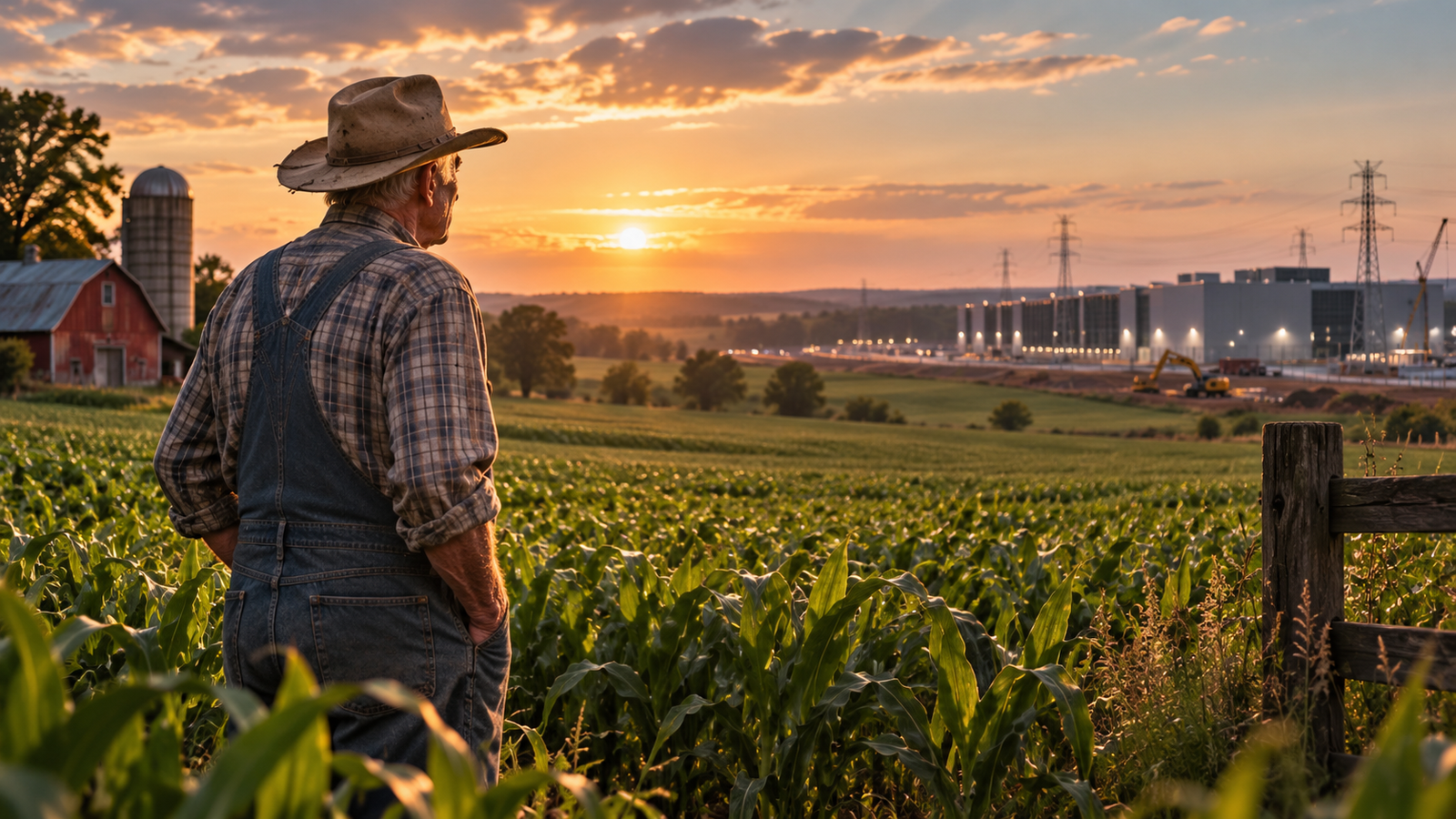
An 86-year-old Pennsylvania farmer was offered the kind of money that could change almost anyone’s life: more than $15 million for the farmland he had spent decades working. He said no.
Mervin Raudabaugh Jr., a longtime farmer in Silver Spring Township in Cumberland County, Pennsylvania, rejected offers from data center developers interested in his two adjoining farms, totaling approximately 261 acres. Instead of accepting the multimillion-dollar development offer, Raudabaugh chose to permanently protect the property as farmland.
His decision is remarkable on its own, but it also raises a much bigger question as artificial intelligence and cloud computing drive demand for increasingly large data centers across the United States: How much agricultural land are communities willing to trade for the physical infrastructure behind our increasingly digital lives?
A Farmer Was Offered More Than $15 Million for His Land
Raudabaugh’s two farms sit in Silver Spring Township near Pennsylvania’s Interstate 81 corridor. Developers reportedly offered approximately $60,000 per acre, putting the potential value of the 261 acres at more than $15 million.
For most families, that kind of offer would be almost impossible to ignore. Raudabaugh declined it and chose a very different financial path: protecting the property through permanent agricultural conservation easements.
That distinction matters. He did not simply sell his farm for a much smaller amount of money. Raudabaugh retained ownership of the property while giving up the right to commercially develop it.
The conservation easement means the land can continue to be farmed and may eventually be sold or transferred to another owner, but future owners cannot simply convert those protected acres into a large commercial, industrial or residential development. In other words, his decision affects not only what happens to the farm today, but what can happen to it decades from now.
The Price of Preserving the Farm
The financial difference between development and preservation was enormous. While developers reportedly offered around $60,000 per acre, Raudabaugh received approximately $7,200 per acre for the agricultural preservation rights, placing the preservation transaction at just under $1.9 million.
That can easily be misunderstood online as a farmer choosing $1.9 million instead of more than $15 million for the same asset. That is not quite what happened.
Raudabaugh still owns the farmland. The preservation payment compensated him for permanently surrendering its development potential. The property itself remains an agricultural asset that can continue producing crops, stay within the family or someday be sold as protected farmland.
What he gave up was the opportunity for himself or a future owner to sell those acres at the much higher prices that commercial development can command.
For Raudabaugh, the Property Was More Than Real Estate
Raudabaugh’s relationship with the farm stretches across much of his life. He spent decades working the property and reportedly milked cows there for 51 years. The land also carries deeply personal family memories, including the barn where his mother died in his arms.
That history makes the decision difficult to measure with a calculator alone. A developer may see acreage, highway access, utilities and future construction. A farmer may see the barn where mornings began before sunrise, fields planted season after season and the landscape that has framed almost an entire lifetime.
Both are measuring value. They are simply measuring it differently.
Why Data Center Developers Are Looking Toward Rural America
Raudabaugh’s story arrives at a moment when data centers are becoming one of the most significant development issues facing communities across the country.
The internet has always required physical infrastructure, but artificial intelligence, cloud computing and other digital services are increasing demand for enormous amounts of computing capacity. Every AI response, streaming service, cloud file, online purchase and digital transaction ultimately depends on physical servers operating somewhere in the real world.
Those servers are housed inside data centers.
Large modern data centers can occupy enormous buildings filled with computing equipment and require substantial electrical capacity, transmission infrastructure, fiber connectivity and cooling systems. As developers search for sites capable of supporting facilities of that scale, large parcels near power infrastructure and major transportation corridors become especially attractive.
Much of that available land is outside dense urban areas. As a result, rural and agricultural communities increasingly find themselves at the center of a development boom created by technologies that consumers may experience entirely through a phone or computer screen.
Cumberland County Shows How Large These Projects Can Become
A separate data center proposal in Cumberland County helps illustrate the scale of the development now being considered in Pennsylvania.
Pennsylvania Digital 1, also known as PAX-1, is planned for approximately 700 acres in Middlesex Township. State information describes a three-campus hyperscale data center project totaling more than four million square feet, with planned electrical capacity of 1.35 gigawatts and the ability to expand to as much as 1.8 gigawatts.
The PAX-1 project is separate from Raudabaugh’s farmland and should not be confused with the offers he received. Its scale, however, demonstrates why farmland advocates and local residents are paying increasingly close attention to data center development.
When a single technology campus can require hundreds of acres and enough electricity to be measured in gigawatts, land-use decisions that once involved a warehouse or shopping center can reshape substantial portions of a rural community.
Artificial Intelligence May Feel Invisible. Its Infrastructure Is Not.
From the consumer side, artificial intelligence can feel almost weightless. We type a question into a phone or computer and receive an answer seconds later. Nothing about that experience necessarily feels industrial.
Behind the screen is something very different. AI and modern cloud computing depend on servers, electrical substations, transmission lines, cooling equipment, backup systems, fiber networks and enormous buildings designed to operate around the clock.
The digital economy has a very physical footprint.
That does not make data centers inherently bad. They support banking, healthcare, communications, entertainment, government systems, business operations and the technology services millions of people now use every day. New facilities can also generate construction activity, tax revenue and economic investment for communities willing to host them.
The difficult question is not whether America should have data centers. We already depend on them.
The question is where they should be built, how large they should become and what communities should protect before development permanently changes the landscape.
Farmland Is Infrastructure Too
Productive farmland is rarely described as infrastructure, but perhaps it should be.
Agricultural land produces food, supports local economies, absorbs rainfall, provides open space and can contribute to wildlife habitat and groundwater systems. In many communities, farming also forms part of the area’s history and identity.
And unlike many developed properties, farmland can be extremely difficult to restore once it has been covered with large buildings, access roads, parking areas, electrical infrastructure and other permanent improvements.
A warehouse can eventually become another warehouse. An office complex can be renovated or redeveloped. Returning a major industrial property to productive agricultural soil is considerably more complicated.
That permanence is one reason farmland preservation programs exist. They allow communities and landowners to make decisions about the future of agricultural property before development pressure becomes overwhelming.
Silver Spring Township Had Already Chosen to Preserve Open Land
Raudabaugh also lives in a community that had already made farmland preservation a public priority. Silver Spring Township voters previously approved dedicated local funding to protect farmland, forests and open space.
That public funding matters because agricultural conservation is not free. When a farmer agrees to a permanent conservation easement, that owner is surrendering development rights that may be worth millions of dollars.
Preservation programs compensate landowners for part of that value while allowing the farms to remain privately owned and agriculturally productive. The community, in return, receives something that can be difficult to purchase once rapid development has already begun: permanently protected open land.
Pennsylvania Is Putting New Guardrails Around Data Center Development
The rapid increase in data center proposals has also prompted Pennsylvania officials to rethink how these projects should be approved.
In August 2026, Governor Josh Shapiro signed an executive order requiring proposed data centers seeking state permits to comply with Pennsylvania’s Responsible Infrastructure Development, or GRID, requirements. Those rules address issues including energy affordability, environmental protection, transparency, workforce development and community involvement.
The state now requires developers to obtain local approval and make legally binding commitments to the GRID requirements before the Pennsylvania Department of Environmental Protection will review certain permit applications. Data centers were also removed from Pennsylvania’s expedited Fast Track permitting program.
The requirements reflect concerns that are appearing well beyond Pennsylvania: Who pays for new electricity infrastructure? How much water will a project require? What happens to utility costs? How many permanent jobs will remain once construction is complete? And how much control should communities have over projects that could permanently reshape where they live?
This Is Not a Story About Farms Being Good and Technology Being Bad
It would be easy to reduce Raudabaugh’s story to a simple argument: farmland good, data centers bad. Reality deserves more nuance.
America wants artificial intelligence. We want powerful technology, instant information, streaming video, cloud storage, digital payments, online shopping and increasingly sophisticated healthcare and business tools. All of those conveniences require physical infrastructure somewhere.
At the same time, America needs food, water, affordable electricity, housing, open space and strong rural economies. Those needs will occasionally compete for the same land and resources.
That means the coming debate cannot simply be about whether development should happen. It must also be about whether we are putting the right development in the right places.
Would You Turn Down More Than $15 Million?
Perhaps the reason Raudabaugh’s story has attracted so much attention is because it forces almost everyone who hears it to privately answer the same question: Would I have taken the money?
More than $15 million could transform a family for generations. It could erase debt, fund retirement, educate grandchildren, create investments and provide a level of financial security most people will never experience.
There would be nothing inherently wrong with another farmer accepting such an offer. Agriculture can be financially difficult, and farmers often operate under pressures that people outside the industry may never see. For some families, selling land may provide the retirement or generational security that decades of farming never could.
Raudabaugh’s decision should therefore not become a moral test for every farmer approached by a developer. It was his property, his circumstances and his choice.
What makes the story compelling is that he apparently knew what mattered most to him before someone placed millions of dollars in front of him.
The Question Is Bigger Than One Farm
Raudabaugh’s approximately 261 acres will remain agricultural land, but the development pressure that reached his doorstep is not disappearing.
Artificial intelligence and the broader digital economy require enormous investments in physical infrastructure. Every new data center must be built somewhere. Every facility occupies land, consumes electricity and becomes part of a community that existed before it arrived.
That leaves cities, counties and states with decisions that are far more complicated than simply being either “for” or “against” technology.
Communities will have to decide which locations make sense for large-scale digital infrastructure, which resources developers should be required to provide themselves, what protections residents deserve and which landscapes should remain untouched.
What Is the Land Worth If You Never Intend to Sell It?
Real estate markets measure land in dollars per acre. Developers calculate what can be constructed on it, investors calculate future returns and governments calculate potential tax revenue.
Families sometimes measure land differently. They measure it in years, harvests, birthdays, work, losses, memories and legacy.
Raudabaugh could have accepted a life-changing amount of money and watched his property become part of America’s rapidly expanding digital infrastructure. Instead, he chose to make sure that long after the technology surrounding his community changes again, those acres can still be farmed.
The AI boom is arriving with an enormous appetite for electricity, infrastructure and land. Communities across America will have to decide how to accommodate that growth without surrendering everything that already has value.
For one 86-year-old Pennsylvania farmer, the decision had already been made.
The money could go. The farm could not.