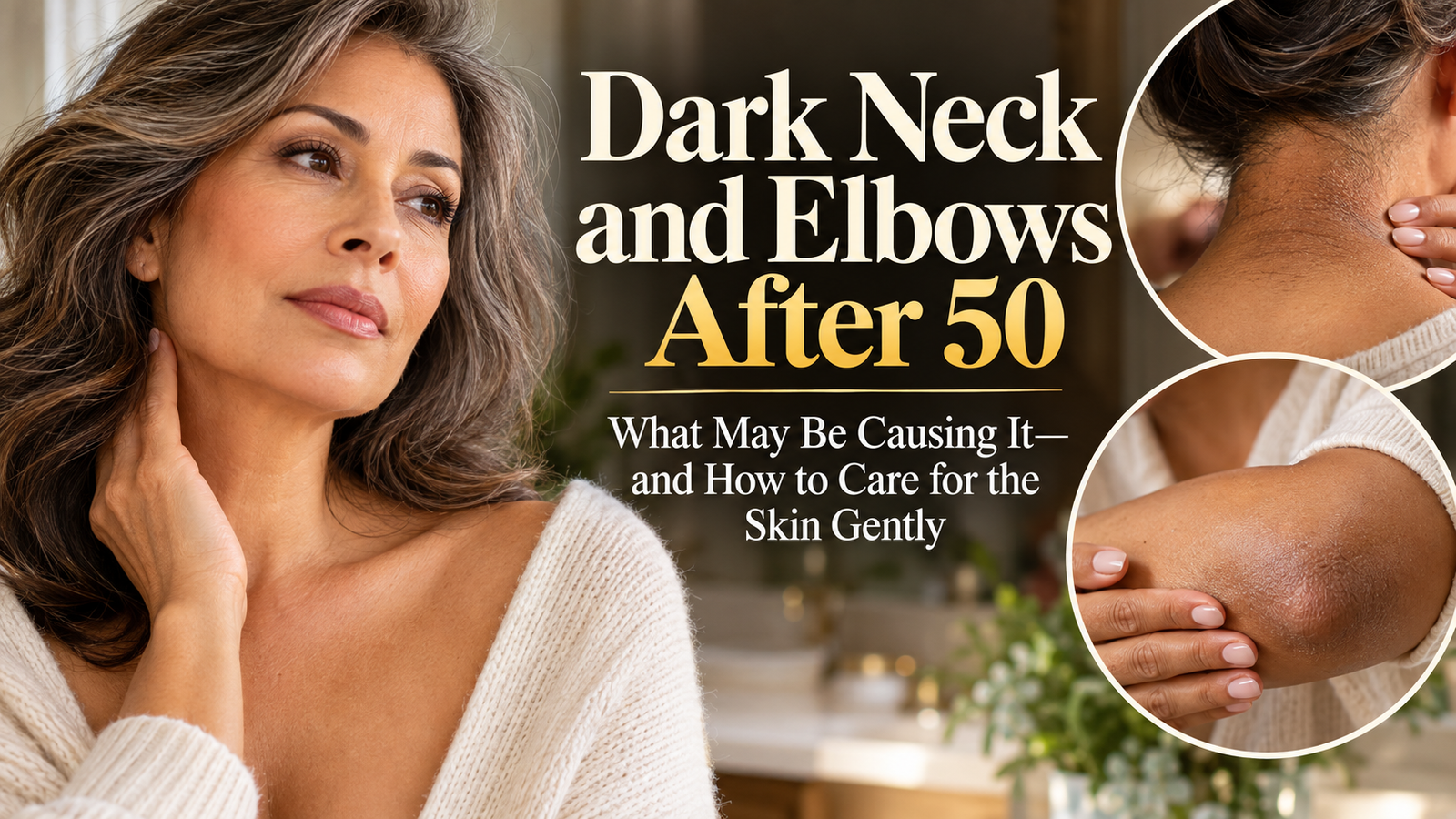
There is a strange little moment that happens somewhere after 50 when you look in the mirror and notice something you don’t remember seeing before.
Maybe it’s the darker skin on the back of your neck. Maybe your elbows suddenly look rougher and darker than they used to. Maybe you’ve noticed darker areas around your knees, knuckles, or other folds of skin.
And naturally, you do what most of us do now: you search for an answer.
That’s when you discover lemon juice, baking soda, aggressive scrubs, bleaching creams, and a dozen different promises that something sitting in your kitchen can make the discoloration disappear.
Before you start rubbing lemon on your neck, though, there’s something worth understanding: darkened skin isn’t always caused by the same thing.
Sometimes it’s dryness. Sometimes it’s friction. Sometimes it’s years of sun exposure or irritation. Sometimes it’s simply a change in the way our skin looks as we get older.
And sometimes, particularly when the skin becomes darker, thicker, and velvety around the neck or other folds, there may be a medical reason worth discussing with your doctor.
The important thing is not to assume.
When Your Skin Starts Looking Different
Our skin doesn’t stay the same throughout our lives. By the time we reach our 50s and beyond, we’ve accumulated years of sun exposure, changes in hormones, environmental exposure, products, irritation, and the ordinary wear and tear that comes with simply living in our skin for decades.
The skin itself also changes with age. It can become drier and more sensitive, and areas that have always been prone to roughness—like the elbows and knees—may become more noticeable.
Elbows, for example, naturally have thicker skin and fewer oil glands than many other areas of the body. When that skin becomes dry and rough, it can look darker or duller than the surrounding skin.
And then there’s friction.
If you spend hours leaning your elbows on a desk, countertop, or armrest, you’re repeatedly putting pressure and friction on the same area. Over time, skin can respond by becoming thicker and rougher.
The answer isn’t necessarily to scrub harder. In fact, that can be exactly the wrong approach.
Sometimes the Problem Is the Way We’re Trying to Fix It
There’s a reason harsh scrubbing can become a frustrating cycle. You see a dark patch, so you scrub it. The skin becomes irritated, and that irritation can cause inflammation. In some cases, that inflammation can leave behind even more discoloration.
This type of darkening is called post-inflammatory hyperpigmentation. It can happen after irritation, scratching, inflammation, sunburn, or an aggressive skincare treatment.
For women with medium-to-deep skin tones, post-inflammatory pigmentation can be particularly persistent. Which means that sometimes the best thing you can do for a dark patch is stop attacking it.
Give the skin a chance to calm down. Moisturize it, protect it from the sun, and figure out what you’re actually dealing with before reaching for something stronger.
Don’t Forget the Back of Your Neck
Most of us have become pretty good at remembering sunscreen on our face. The neck? That’s another story.
The back and sides of the neck can receive years of sun exposure, and it’s an area that’s easy to overlook when we’re applying sunscreen in the morning. Cumulative sun exposure can contribute to uneven pigmentation and other visible changes in the skin.
That doesn’t mean sunscreen is going to erase an existing dark patch. It won’t. But protecting exposed skin from additional sun damage is one of the simplest things you can do for your skin over time.
And if you’re someone who spends a lot of time outdoors—or even spends a lot of time driving—your neck deserves the same attention as your face.
Not Every Dark Patch Is Just Aging
This is where it gets important to slow down.
A new dark patch shouldn’t automatically be dismissed as “just getting older.”
One skin condition worth knowing about is called acanthosis nigricans. The name sounds much more frightening than the condition itself.
Acanthosis nigricans causes areas of skin to become darker and thicker, often with a characteristic velvety texture. It commonly appears on the back of the neck, in the armpits, and in the groin, but it can also appear on areas such as the elbows, knees, and knuckles.
The affected skin can sometimes also develop skin tags, itching, or an odor.
And here’s something important: it isn’t something you can simply scrub away.
If you’ve ever looked at a dark patch and thought, “Maybe I just need to exfoliate this better,” you’re not alone. But vigorous scrubbing won’t remove acanthosis nigricans, and irritating the skin can make matters worse.
What Can Cause Acanthosis Nigricans?
Acanthosis nigricans is often associated with insulin resistance. Insulin resistance means the body’s cells aren’t responding to insulin as effectively as they should, and it is associated with prediabetes and type 2 diabetes, among other conditions.
Certain medications can also contribute to the condition.
And in rare cases, acanthosis nigricans can be associated with an underlying cancer. That last part can sound alarming, so let’s put it into perspective.
A dark patch does not automatically mean you have diabetes. And it certainly does not automatically mean you have cancer.
What it means is that a particular pattern of skin change can sometimes provide a clue about what’s happening elsewhere in the body. That’s why a new, unexplained, thickened, velvety patch is worth having evaluated rather than assuming it’s simply an aging or cosmetic issue.
When It’s Worth Making the Appointment
You don’t need to panic every time you notice a change in your skin. But you also don’t need to ignore it.
If an area of skin becomes noticeably darker, thicker, or velvety—particularly on the back of the neck or in another skin fold—bring it up with your doctor or dermatologist.
Pay particular attention if the change appeared suddenly or if several dark, velvety patches develop.
Most of the time, there is a manageable explanation. But the point of having it checked isn’t to assume the worst. It’s to find out what you’re actually dealing with.
A skincare routine can help support healthy skin. It cannot tell you why a new skin change appeared.
That’s what a medical evaluation is for.
So What Can You Do at Home?
For discoloration related to dryness, friction, sun exposure, or irritation, gentle care is a much better place to start than aggressive treatments.
Think consistency rather than intensity.
A good fragrance-free moisturizer can help dry, rough areas feel softer and more comfortable. Ingredients such as ceramides, glycerin, and hyaluronic acid are commonly used to support the skin barrier.
You don’t need a bathroom shelf full of products. You need a routine you’ll actually use.
If rough skin is part of the problem, gentle exfoliation may sometimes help, but more isn’t necessarily better. Strong acids, aggressive scrubbing, abrasive brushes, and repeated treatments can irritate the skin and potentially contribute to more discoloration.
And if you suspect the darkening could be acanthosis nigricans, don’t assume an exfoliant or brightening cream is the answer. Bleaching creams and exfoliants may irritate the skin and aren’t a reliable solution for the underlying condition.
Your skin doesn’t need to be punished into looking better.
It needs to be understood.
And About That Lemon Juice…
Let’s talk about the home remedy that refuses to disappear.
Lemon juice.
You’ve probably seen it recommended for everything from dark elbows to dark knees to dark spots on the face. It sounds harmless because it’s natural.
But natural doesn’t automatically mean gentle.
Lemon and other citrus fruits contain compounds that can react with sunlight and cause a skin reaction known as phytophotodermatitis. That reaction can result in redness, burning, swelling, blistering, and subsequent discoloration.
So the irony is that you can put lemon on your skin because you’re trying to get rid of a dark patch—and end up creating another irritated, discolored area.
And then there’s baking soda.
It’s another popular DIY recommendation, often combined with lemon juice or used as a homemade scrub. But if friction and irritation can contribute to discoloration, aggressively rubbing an already-dark area isn’t exactly helping the situation.
Your skin is not a countertop.
You don’t need to scrub away the evidence of being 50, 60, or 70.
What About Brightening Products?
There are legitimate dermatological treatments for certain types of pigmentation.
The important word is certain.
A product that works for one type of discoloration may do very little for another. And a product that is too irritating for your skin can potentially create more inflammation and more pigmentation.
That’s why persistent or stubborn discoloration is one of those situations where professional advice can save you a lot of trial and error.
A dermatologist can determine whether you’re dealing with pigmentation, thickened skin, acanthosis nigricans, irritation, or another skin condition and recommend treatment based on the actual cause.
That’s very different from buying the strongest “brightening” product you can find online and hoping it works.
Maybe This Is Part of What Changes After 50
There is something else worth remembering.
Getting older isn’t a problem that needs to be corrected.
Our skin changes because we change.
We’ve spent decades in the sun. We’ve lived through hormonal changes. We’ve dealt with stress, weather, products, inflammation, illness, and all the ordinary things that leave their mark on a human body.
That doesn’t mean we have to ignore changes we don’t like. It simply means we can approach them differently.
Instead of immediately asking, “How do I get rid of this?”
Sometimes the better question is:
“Why is this happening?”
That question can lead to a much better answer.
The Kind of Skin Care We Deserve Now
After 50, skincare doesn’t have to become a battle against every sign that time has passed.
We can still care about how our skin looks. We can still want smoother elbows, more even-looking skin, and a neck we feel comfortable showing.
But we don’t have to attack our skin to get there.
Moisturize it. Protect it. Be careful with products that irritate it. Skip the kitchen chemistry experiments.
And when something changes in a way you don’t understand, ask someone who can actually tell you why.
A darker neck or elbows doesn’t automatically mean something is wrong. Dryness, friction, sun exposure, irritation, and other everyday factors can all change the way our skin looks.
But a new, thickened, velvety dark patch—especially on the back of the neck—is worth paying attention to.
Not because you should be frightened.
Because your skin sometimes tells you things.
And after 50, we’ve lived long enough to know that listening is usually smarter than guessing.
This article is for educational and informational purposes only and is not medical advice. It is not intended to diagnose, treat, cure, or prevent any medical condition. If you notice new, sudden, changing, thickened, or unusually dark areas of skin, speak with a qualified healthcare professional or dermatologist for an appropriate evaluation.