
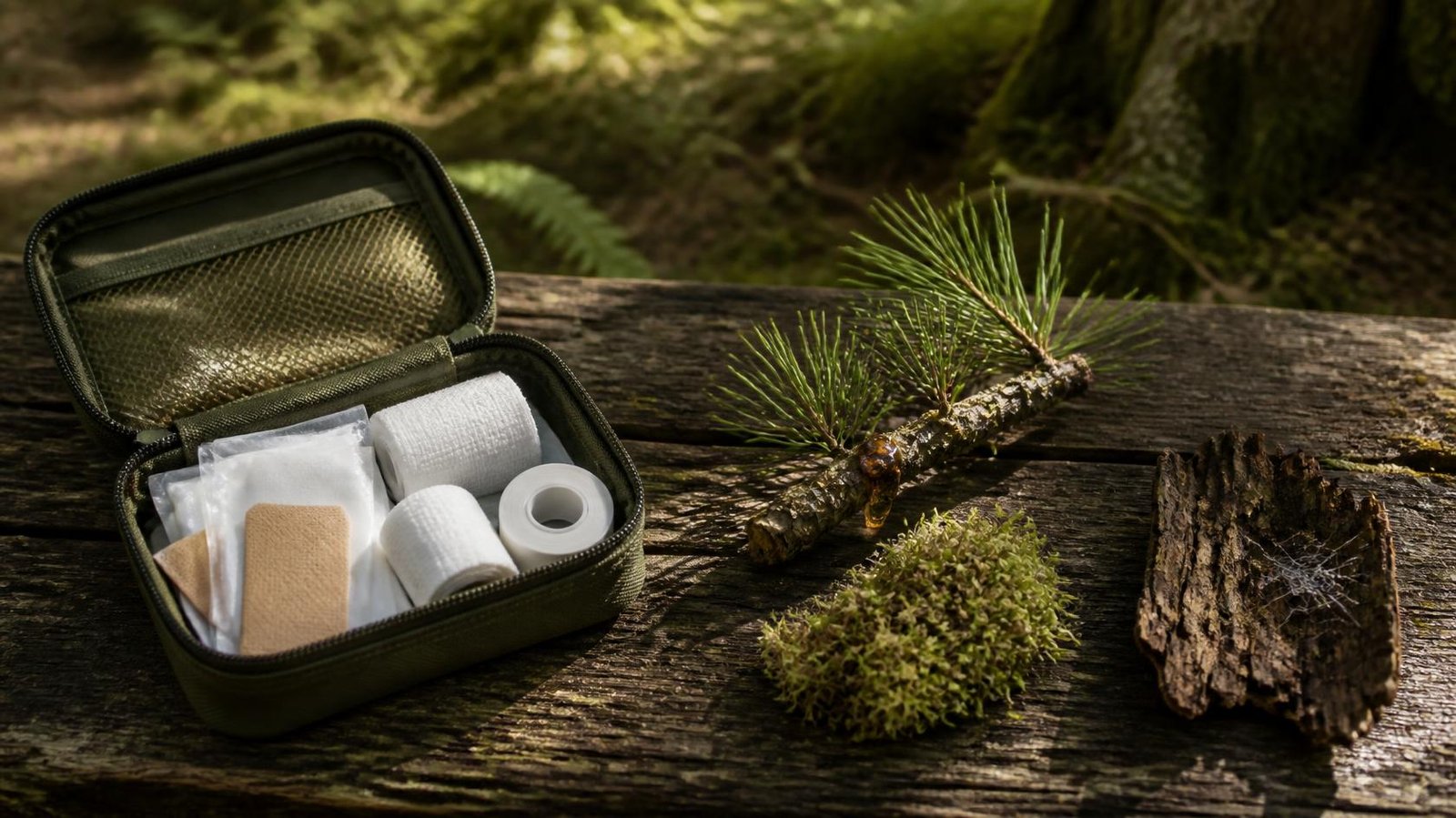
There’s a genre of outdoor video built around a satisfying premise: you don’t need a first aid kit, because the forest already has one. A recent viral clip calls tree resin “nature’s liquid Band-Aid” and runs through several more wild materials people have used on wounds for centuries. It’s genuinely interesting history. It’s also, according to the people who actually treat wounds for a living, not something you should be doing to an open cut today. This article is a fact-check, not a how-to — here’s the honest breakdown of five commonly claimed “bushcraft Band-Aids”: what’s real history, what’s real lab or clinical evidence, and what modern medicine actually recommends instead.
1. Pine Resin — “Nature’s Liquid Band-Aid”
The claim: Tree resin (pine, spruce, fir) can be applied hot and sticky directly onto a wound to seal it and prevent infection.
What’s real: This is the item with the strongest clinical evidence of the five, and it’s worth being precise about what that evidence actually covers. A randomized, controlled multicenter trial published in the British Journal of Dermatology in 2008 tested a medical-grade Norway spruce (Picea abies) resin salve against a standard wound-care hydrocolloid dressing in 37 patients with severe pressure ulcers, finding significantly better healing rates in the resin group. Follow-up research from the same research group, including a pilot trial on complicated surgical wounds and laboratory work showing bacteriostatic effects against bacteria including MRSA, has continued to support the salve’s effectiveness. This isn’t folk medicine dressed up — it’s a real, purified medical product (marketed as Abilar) with a genuine clinical trial history behind it.
The gap: Every one of those results comes from a purified, standardized 10% medical-grade resin formulation, applied under clinical supervision. That is not the same substance as raw sap wiped off a tree trunk. Wild sap can carry bark debris, insects, mold, and whatever else has touched the tree, and pine and spruce resin (as colophonium/rosin) are well-documented, long-recognized causes of allergic contact dermatitis in dermatology — a risk that exists for the purified product too, which is why even the clinical version is evaluated for skin sensitization before use. Applying resin hot, as some bushcraft demonstrations show, adds a burn risk on top of everything else. The clinical evidence supports a specific manufactured product — not the practice shown in the video.
2. Plantain Leaf Poultice
The claim: Chewing or crushing plantain leaves (Plantago major, the common lawn weed — not the banana relative) into a paste and applying it to a wound reduces swelling and helps healing.
What’s real: Plantain has a long history of folk use for skin irritation, and some laboratory studies have examined compounds in the plant for anti-inflammatory activity in controlled settings.
The gap: A crushed leaf pulled from the ground — or chewed and spat onto a wound, a version of this remedy that shows up repeatedly in bushcraft content — introduces saliva-borne bacteria and whatever the plant itself picked up from soil, insects, or animal contact directly into broken skin. There is no clinical evidence supporting this specific application (raw, unwashed plant matter, potentially pre-chewed) as safe for open wound care, and mainstream wound-care guidance does not recommend it.
3. Yarrow (Achillea millefolium)
The claim: Crushed yarrow leaves stop bleeding and disinfect small cuts — one of the most repeated plants in this genre, historically linked to battlefield wound care going back to antiquity.
What’s real: Peer-reviewed, PubMed-indexed studies have found yarrow extracts show measurable antimicrobial and antibiofilm activity against bacteria commonly found in human wounds, including Staphylococcus aureus, and animal studies have found accelerated wound closure using yarrow extract compared to untreated controls.
The gap: Every one of those studies uses a prepared, concentrated plant extract in a controlled lab or animal setting — not a wild leaf, crushed by hand outdoors and packed directly into a cut. That’s a meaningful difference in both concentration and, more importantly, contamination control. A yarrow extract prepared in a lab is a defined, tested substance. A yarrow leaf growing beside a trail is not.
4. Spiderweb / Cobwebs
The claim: Pressing spiderweb onto a cut stops bleeding and prevents infection, sometimes attributed to a high vitamin K content.
What’s real: This is one of the oldest folk remedies in the list, and it shows up across many cultures historically. Spider silk itself is a structural protein.
The gap: This is the weakest-supported claim of the five, and it’s important to be direct about that rather than softening it. A search of peer-reviewed and clinical literature turned up no credible evidence supporting either the antimicrobial claim or the “high vitamin K” explanation commonly repeated for this remedy online — that specific explanation appears to trace back to enthusiast and homesteading blogs rather than any laboratory or clinical source, and this article does not repeat it as fact. Practically, a web collected outdoors is exactly as uncontrolled as any other wild material — dust, insect parts, and whatever the web has trapped come along with it. Of the five items here, this one has the least evidence and arguably the highest contamination risk, since spiderwebs exist specifically to trap debris.
5. Sphagnum Moss
The claim: Moss can be packed onto a wound as an absorbent, antiseptic dressing — often cited alongside its genuinely well-documented use in World War I field medicine.
What’s real: This is a real and well-researched piece of medical history. Sphagnum moss was used at enormous scale for wound dressings in WWI, prized for absorbing far more fluid than cotton and for a mild antiseptic effect linked to the moss’s naturally acidic cell chemistry. A peer-reviewed historical and pharmacological review confirms both the absorbency and the antiseptic mechanism were genuine.
The gap, and it’s the important one: That same peer-reviewed review notes something bushcraft content typically leaves out entirely: the moss used in WWI dressings was not packed onto wounds straight from the bog. It was cleaned of debris, dried, and processed into dressings before use — and the review specifically states that early tests of the antiseptic properties of raw, unsterilized peat moss actually failed; it was the sterilization and processing that made the wartime dressings safe and effective, not the moss alone in its wild state. Unsterilized moss pulled directly from the ground today has not gone through that process, and current wound-care guidance does not support using it that way.
The Core Problem, Stated Plainly
Across all five of these, the same issue repeats: whatever beneficial compounds a wild plant, fungus, or material might contain, none of these forms as they exist in nature are sterile, and applying an uncontrolled substance to broken skin creates real infection risk. This isn’t just a cautious opinion — it matches the actual clinical wound-care literature directly. A 2015 evidence-based practice guideline published in Advances in Wound Care, developed by a multidisciplinary panel using formal evidence-grading methods, concludes that acute open wounds are best cleansed with lukewarm, drinkable water and simple, standard dressings — not foraged materials of any kind.
What Modern Wound Care Guidance Actually Recommends
According to Mayo Clinic’s first aid guidance for cuts and scrapes, the actual recommended steps are:
- Wash your hands before touching the wound.
- Stop the bleeding with direct pressure using a clean cloth or bandage, elevating the area if possible.
- Rinse the wound thoroughly with clean water — Mayo Clinic specifically advises against using hydrogen peroxide or iodine on the wound itself, as both can irritate healthy tissue.
- Apply a thin layer of antibiotic ointment or plain petroleum jelly to keep the wound moist.
- Cover it with a clean bandage and change the dressing daily.
- Watch for signs of infection — increasing redness, warmth, swelling, pain, or drainage — and see a healthcare professional if they appear.
Notably absent from that list, anywhere: foraged plants, tree sap, spiderwebs, or moss.
Tetanus and Wild Wounds
This is where wilderness settings specifically raise the stakes. According to CDC clinical guidance on tetanus, wounds are categorized by risk level, and “dirty or major” wounds — including those contaminated with soil, saliva, or containing devitalized tissue — carry meaningfully higher risk than clean, minor ones. Deliberately packing a wound with soil-contaminated plant matter, unwashed bark resin, or debris-laden spiderweb pushes a wound further toward that higher-risk category, not away from it. If you haven’t had a tetanus booster in the past five years and sustain a deep or dirty wound outdoors, Mayo Clinic recommends getting one within 48 hours of the injury.
When a Wound Needs Professional Medical Care
Based on standard medical first aid guidance, seek medical attention if a wound:
- Won’t stop bleeding after several minutes of direct pressure
- Is deep, gaping, or has jagged edges that don’t come together easily
- Was caused by an animal or human bite
- Contains dirt or debris that can’t be fully removed by rinsing
- Shows signs of infection developing (redness, warmth, swelling, pain, or drainage)
- Occurs in someone who hasn’t had a tetanus booster in the past five years and the wound is deep or dirty
This list reflects when to involve a professional — it isn’t a substitute for one, and it doesn’t cover every situation. When in doubt about a wound, especially a deep or dirty one sustained outdoors, medical guidance consistently favors erring toward professional evaluation rather than waiting.
The Honest Takeaway
The history here is genuinely interesting — yarrow really has been used on wounds for thousands of years, sphagnum moss really did help reduce infection in WWI field hospitals once properly processed, and pine resin’s antimicrobial properties are real enough that a purified, clinically-tested medical product exists and has published trial data behind it. None of that is myth. What doesn’t hold up is the leap from “this substance has documented properties in a purified, sterile, controlled form” to “therefore the wild, unwashed version is safe to press into an open wound.” That’s the gap between interesting bushcraft history and actual first aid — and it’s the gap the viral clip skips right over.