Search “vintage Christmas ornaments” and you’ll get two very different things: genuinely old pieces with real history, and modern reproductions trying to look old. Both have a place on a tree. But if you’re trying to build a collection that actually feels nostalgic rather than costume-y, it helps to know what you’re looking at — and what makes an ornament read as authentically old in the first place.
Mercury Glass (Kugel-Style and Later Mercury Glass)
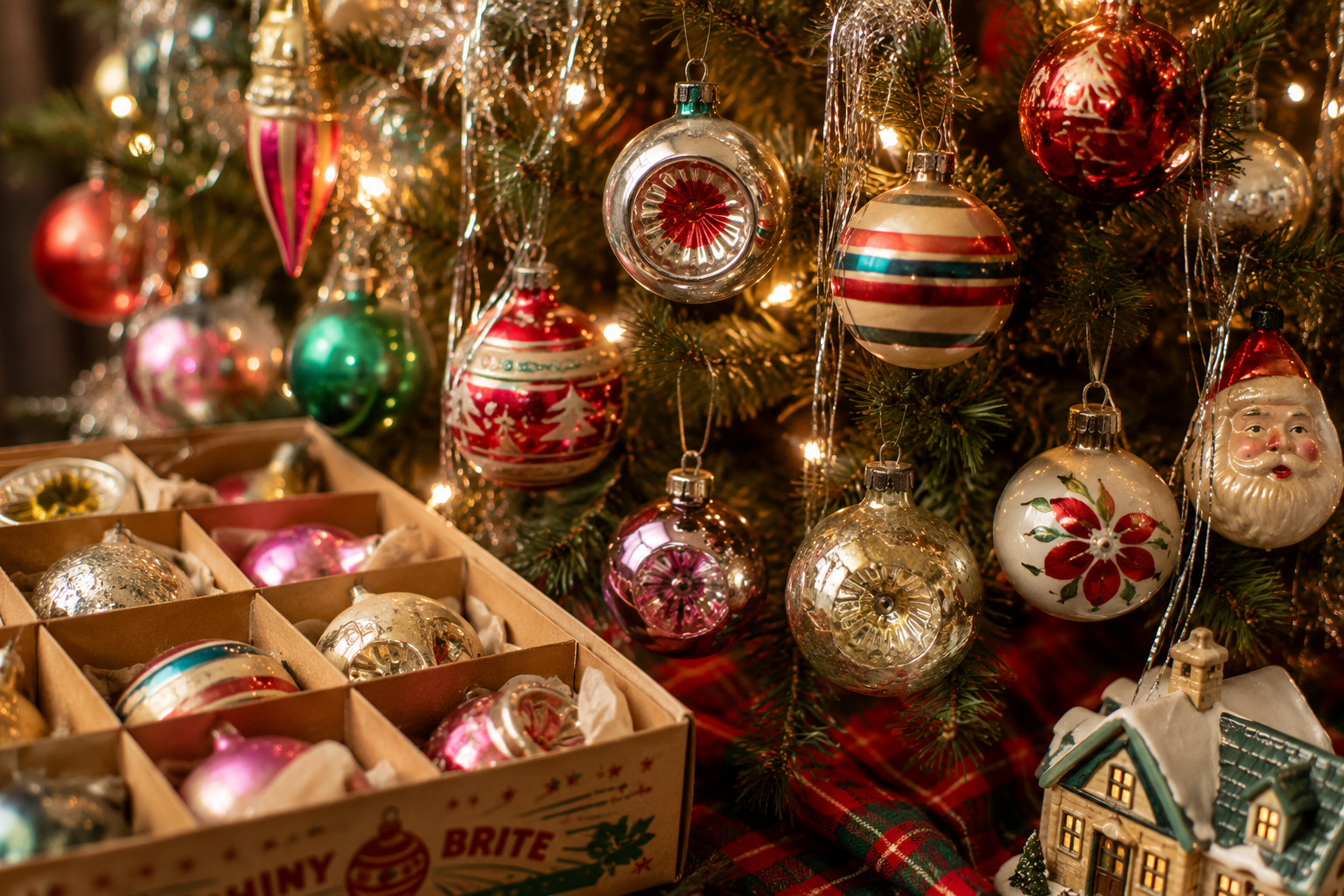
True mercury glass ornaments are blown glass with a silvered interior coating, and they were especially popular from the early-to-mid 20th century onward. The telltale signs of genuinely vintage pieces are a slightly uneven silvering, visible wear at the cap, and a certain heft that modern lightweight glass doesn’t have. Reproduction mercury glass is widely available now and can look convincing — it’s just worth knowing you’re buying new-made rather than genuinely old if authenticity matters to you.
Hand-Painted Glass Figural Ornaments
Figural ornaments shaped like fruit, birds, houses, or Santa figures, hand-painted rather than printed, were common through much of the 20th century, particularly pieces associated with German and Eastern European glassblowing traditions. Look for visible brushstrokes and slight asymmetry — perfectly uniform paint application usually signals a modern piece.
Shiny Brite and Similar Mid-Century Glass Balls
Simple round glass ball ornaments in bold, saturated colors — often with a stripe or simple pattern — are strongly associated with mid-20th-century American Christmas trees. These are some of the most widely collected and most affordably found vintage ornaments, since so many were produced.
Plastic and “Indent” Ornaments
Later in the century, plastic ornaments — including the “indent” style with a small recessed scene inside — became common and are now their own nostalgic category, particularly for anyone who grew up in the ’60s through ’80s. These are often overlooked by more traditional “vintage” collectors but are genuinely meaningful for that specific generational memory.
Handmade and Craft Ornaments
Felt, yarn, popcorn strings, paper cutouts, and other handmade ornaments carry a different kind of nostalgia — less about a specific manufacturing era and more about a specific memory of who made it. These don’t need to match anything else on the tree to belong there.
How to Mix Eras Without It Looking Random
The trick to a tree with genuinely vintage character isn’t matching every ornament’s era — it’s keeping a loose thread of color or material connecting them. A tree mixing 1950s glass balls, a ’70s plastic indent ornament, and a handmade felt piece from last year can absolutely work, as long as the overall palette stays cohesive rather than every ornament fighting for attention in a different color family.
Where to Actually Find These
Estate sales, antique malls, and inherited family collections are the most reliable sources for genuinely old pieces. Online vintage marketplaces are useful but require more care — condition and authenticity claims vary widely, so it’s worth looking closely at photos before buying anything described as vintage, especially glass.
What Actually Makes an Ornament Feel Nostalgic
It’s rarely about age alone. It’s the slight imperfection, the visible hand of whoever made or painted it, the sense that it survived being packed away and unpacked dozens of times. A brand-new “vintage-style” ornament, if it has that same softness and imperfection built in, can absolutely earn a place on a genuinely nostalgic tree — it’s the perfectly uniform, mass-produced pieces that tend to break the spell.